Search Results

Designed by Pickard Chilton, the New Campus integares offices, amenities, education, and retail with three acres of green space overlooking the James River.


“This isn’t just a building, it’s a commitment for the employees and people around it,” Chilton said at a morning open house event with company executives and guests. “The design steps down to the river, and it’s a campus that opens up to the rest of the city. A building is only as alive as the people it draws through the doors, and the people here are doing their best thinking.”
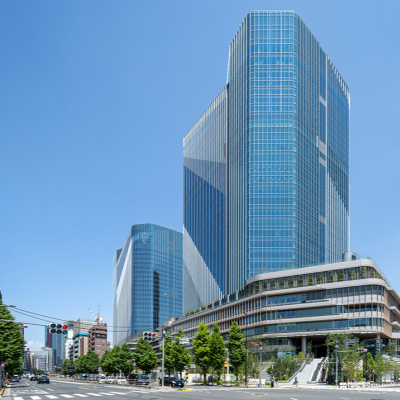
A pair of landmark twin towers rising approximately 160 meters has been completed in front of JR Yamanote Line’s Takanawa Gateway Station, forming a new symbol of international exchange. A completely new urban district has opened in Takanawa—the birthplace of innovation where Japan’s first railway ran over the sea more than 150 years ago.

Entire towers assembled through hybrid systems once considered impossible are now redefining the future skyline. Pickard Chilton’s Foundry South, a 121-foot-tall amenity building in Richmond, Virginia, is another recent example....the steel-and-timber hybrid structure is one of the first of its kind in the U.S. Serving as a corporate campus hub with an auditorium, cafeterias, and a gymnasium, the building required large, column-free spans suitable for steel construction.

12-Story Boutique Office and Retail Project Under Development by
Trammell Crow Company and BDT & MSD Partners
(New Haven, Conn. – May 11, 2026) – Pickard Chilton, an award-winning architecture studio best known for its innovative and cutting-edge design of corporate headquarters and campuses as well as civic and cultural institutional projects, announces that Knox & McKinney, a boutique office and luxury retail building in Dallas, Texas, has broken ground. The studio is serving as design architect for the 12-story project under development by Trammell Crow Company, BDT & MSD Partners, Gillon Property Group, The Summers Group, and The Retail Connection.
The Class AA building will rise at 4544 McKinney Avenue, on the corner of McKinney Avenue and Knox Street in Dallas’ Knox Street neighborhood. Thoughtfully crafted for contemporary tenants, Knox & McKinney will offer 280,000 square feet of premier office space alongside 20,000 square feet of curated ground-floor retail and dining. HKS is the project’s architect of record, while DPR Construction is serving as general contractor.
“Knox & McKinney reflects the continued evolution of the workplace as a destination, one that brings together design, performance, hospitality, and a meaningful connection to its urban context,” said Jon Pickard FAIA, principal of Pickard Chilton. “Our design responds to the energy and scale of Knox Street, while creating flexible, light-filled work environments and an active street-level presence that contributes to the pedestrian experience. We are proud to continue our work in Dallas with Trammell Crow Company and to help bring this landmark project to life.”
Pickard Chilton’s design features a high-performance curtain wall system with natural stone accents, large, insulated glass units with sweeping curved corners that soften the building’s presence while offering panoramic views across Knox and toward downtown Dallas. Conceived as a collection of articulated volumes carefully modulated in response to the site and surrounding urban context, the building provides access to terraces on multiple levels, while large, column-free floor plates and floor-to-ceiling glazing support flexible, light-filled work environments.
At the ground level, Knox & McKinney is designed to activate the public realm through retail and restaurant opportunities, a welcoming office lobby, and boutique office space overlooking the street. A modulated brick façade and steel windows help integrate the project with the architectural character of Knox Street.
Hospitality-inspired amenities, including a high-end fitness center, a tenant lounge and private bar, multiple terraces for indoor-outdoor workstyles, and a state-of-the-art conference and boardroom facilities, support a contemporary workplace experience connected to the neighborhood’s shops, restaurants, and the Katy Trail.
Jones Day, one of the world’s largest law firms, has signed a 76,000 square-foot lease at the building.
The project builds on Pickard Chilton’s longstanding work in Dallas and its collaboration with Trammell Crow Company, which began in 2020. Knox & McKinney further reflects the studio’s focus on contemporary workplace environments that combine architectural distinction, high-end performance design, and a strong relationship to the city.
ABOUT PICKARD CHILTON
Pickard Chilton is an international architectural practice noted for its expertise in the design of large, complex, and often high-profile buildings including corporate headquarters, high-rise commercial office and multi-family towers, luxury hotels, and academic and life science facilities. The firm’s layered perspective informs all of its work, presenting clients with a sophisticated, knowledge-based approach that emphasizes design vision, placemaking, integrity, a focus on client objectives, and exceptional service. Since 2006, projects totaling over 80 million square feet have been designated or targeted LEED Gold or Platinum, representing corporate, commercial, residential, and institutional buildings in design, under construction, or completed – one of the highest amounts in the United States. Headquartered in New Haven, Conn., the firm’s recent completed projects include the Tokyo Midtown Yaesu tower in Tokyo, Japan; 600 Fifth in Washington, DC.; The Eight in Bellevue, Wa.; and, AstraZeneca’s new R&D facility in Cambridge, Ma. Current projects include The RO development in Houston, Tx.; CoStar Group’s new corporate campus in Richmond, Va.; the St. Regis Residences and the Ritz Carlton Residences, both in Houston, Tx.; Sherwin-Williams’s new headquarters in Cleveland, Oh.; Northwestern Mutual’s North Office Building in Milwaukee, Wi; Mutual of Omaha’s new headquarters in Omaha, Ne;. and Linkpillar 1 at Takanawa Gateway City in Tokyo, Japan; as well as commercial and residential developments in Austin, Atlanta, Dallas, Denver, Houston, San Francisco, and Stuttgart, Germany. Please visit www.pickardchilton.com for more information.
ABOUT TRAMMELL CROW COMPANY
Trammell Crow Company (TCC) is a leading commercial real estate developer and wholly-owned subsidiary of CBRE Group, Inc. (NYSE:CBRE), a Fortune 500 and S&P 500 company headquartered in Dallas. Founded in 1948, TCC has developed or acquired 3,000 buildings valued at $90 billion spanning more than 700 million square feet. As of March 31, 2026, TCC had nearly $30 billion of projects in process or its pipeline. With approximately 465 employees throughout the United States and Europe in 26 offices, the company serves users of and investors in office, industrial/logistics, healthcare, life science, data center, mixed-use, and multifamily projects through its residential subsidiary, High Street Residential. For more information visit www.TrammellCrow.com.

A globally recognized architect, educator, and College of Design alumnus, William D. Chilton returns to inspire the Class of 2026.

Bathija said the idea that some buyers might want to acquire multiple units was factored into the building’s initial design, which was overseen by New Haven, Connecticut-based Pickard Chilton in collaboration with Houston-based Kirksey Architecture and Dallas-based interior design firm ForrestPerkins.
“We have the flexibility to combine select units to accommodate homeowner requests for larger floorplans,” Bathija said. “When you consider that prior to today’s groundbreaking (ceremony) penthouses have achieved record-breaking prices and pre-sales, it is evident Houstonians are responding to the new paradigm of residential experience we are offering. And this is Texas, where everything is bigger.
As the St. Regis Residences breaks ground near Memorial Park Wednesday, all seven of the project’s penthouses have presold, including two residences at potentially record-setting prices.
Overall, about 45% of the development’s 90 residences are now under contract, exceeding Bathija’s expectations. The high-rise at 102 Asbury Street is slated to complete in 2029.
The St. Regis Residences is the latest sign that Houston’s luxury condominium market is starting to mature as the city’s ultra-luxury buyers increasingly commit to multimillion-dollar condos well before they’re built.
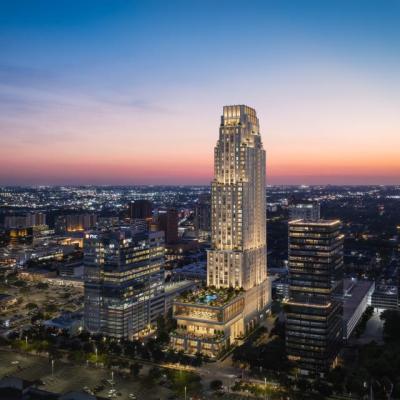
A penthouse at the forthcoming Ritz-Carlton Residences, Houston that’s asking $30 million is in contract to sell in what is likely to be a record condo deal for Texas.
In addition to the residences, there will also be a 156-room Ritz-Carlton hotel. The project’s architect or record is Houston-based firm Ziegler Cooper Architects, with design by Connecticut-based architectural firm Pickard Chilton.

Developed over nearly two decades, the area surrounding Takanawa Gateway Station has been conceived as an “experimental platform for well-being over the next 100 years.” It presents a new urban model where business, culture, and daily life intersect within a single, integrated framework.